

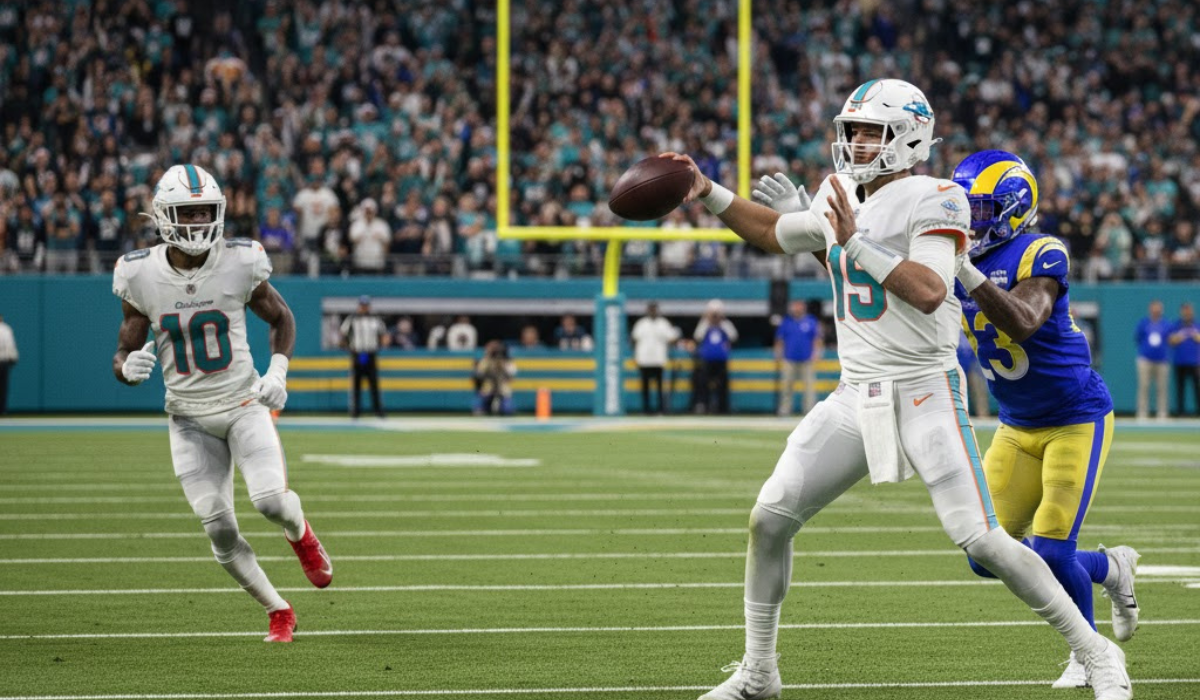
In the NFL, the final score is the ultimate arbiter of success, but it often tells only a fraction of the story. To truly understand the dynamics of a game, one must delve into the individual performances that collectively shape the outcome. The recent clash between the Miami Dolphins and the Los Angeles Rams on November 11, 2024, at SoFi Stadium is a perfect case study. While the Dolphins emerged with a 23-15 victory, the box score reveals a contest of contrasting philosophies and key individual battles where efficiency and opportunism triumphed over sheer volume. This analysis of the Miami Dolphins vs Los Angeles Rams match player stats uncovers the real narrative behind the numbers.
The Quarterback Duel: Efficiency vs. Volume
The tale of the two quarterbacks encapsulates the entire game’s theme.
For the Miami Dolphins, Tua Tagovailoa operated with surgical precision. His final line—20 completions on 28 attempts for 207 yards, one touchdown, and one interception—may not leap off the page, but it exemplifies a game-manager at his most effective. Tagovailoa’s 71.4% completion rate allowed Miami to sustain drives and, crucially, control the game’s tempo. His lone touchdown pass, a connection with Tyreek Hill, was a masterclass in taking what the defense gave him at a critical moment. The interception was a blemish, but Miami’s defense and run game ensured it wasn’t a catastrophic one. Tagovailoa’s performance was a lesson in calculated, low-risk football that prioritized field position and ball control.
On the other side, Matthew Stafford of the Rams put up the kind of stat line that often leads to a win. He was a volume passer in every sense, attempting 44 passes and completing 32 for 293 yards. He moved the chains consistently, evidenced by the Rams’ superior total yardage (327 to Miami’s 238). However, the critical difference lay in the red zone and in one pivotal mistake. Stafford’s sole interception, snagged by Miami’s linebacker Anthony Walker Jr., came early and stymied a promising Rams drive, shifting momentum to the Dolphins. Despite his yardage, Stafford could not pilot his offense into the end zone, with the Rams settling for field goals on multiple occasions. His numbers speak to persistence, but Tagovailoa’s speak to poise and efficiency.
Rushing Attacks: The Tone-Setting Play
While this game was not a ground-and-pound affair in terms of total carries, the running game produced its most decisive moment right from the start.
Miami’s De’Von Achane and Raheem Mostert provided their typical explosive change-of-pace, but it was Salvon Ahmed whose number was called for a play that set the tone. Ahmed’s 18-yard touchdown run on the opening drive was a statement. It immediately put the Rams on the back foot, forced them to respect the play-action, and gave the Dolphins a lead they would never relinquish. This early success on the ground established a balance that the Rams’ defense had to account for all afternoon, opening up passing lanes for Tagovailoa later on.
The Rams’ ground game, led by Kyren Williams, found it difficult to establish a consistent rhythm against a stout Miami front. Williams was able to chip away for modest gains, but the Rams’ inability to find a consistent rushing threat, especially in short-yardage and red-zone situations, became a glaring issue. It forced Stafford into obvious passing situations, allowing Miami’s pass rushers to pin their ears back.
Receiving Corps: The Hill vs. Kupp/Nacua Showdown
The battle between the receivers was a fascinating study in quality versus quantity.
For Miami, Tyreek Hill was, as always, the focal point. While his yardage total was uncharacteristically modest, his impact was profound. He hauled in the game’s only receiving touchdown, demonstrating that even on a day where he might be contained for large stretches, his threat is ever-present and often decisive. His ability to command double coverage also created opportunities for other receivers like Jaylen Waddle to operate in space, keeping the chains moving.
The Rams’ duo of Cooper Kupp and Puka Nacua put up impressive individual numbers, combining for a significant portion of Stafford’s 293 passing yards. They ran crisp routes, found soft spots in the Miami zone, and consistently made plays to advance the ball. However, their prolific stat lines ultimately ring hollow in the context of the loss. Their production was accumulated between the 20-yard lines; once the field shortened, the Dolphins’ defense clamped down, rendering the Rams’ star receivers’ stats a testament to empty calories rather than nourishing touchdowns.
Defensive and Special Teams: The Deciding Factors
This is where the game was truly won and lost. The raw yardage totals suggested a Rams victory, but the defensive and special teams’ stats reveal the truth.
The Miami defense was the epitome of “bend but don’t break.” They surrendered yards but became a brick wall in the red zone, holding the Rams to 0-for-3 on red zone attempts. This resilience was fueled by a pass rush that recorded four sacks, consistently pressuring Stafford at critical moments. The interception by Anthony Walker Jr. was a classic example of a defense capitalizing on an opponent’s mistake. Furthermore, Miami’s discipline was impeccable, being flagged only once for 15 yards, a stark contrast to the Rams’ six penalties for 64 yards. This lack of self-inflicted wounds kept them ahead of the chains and out of disastrous situations.
The Rams’ defense played admirably, sacking Tagovailoa three times and securing an interception of their own. However, they couldn’t replicate Miami’s key stops. They allowed the early touchdown run and, on a day where their offense was sputtering, could not produce the game-changing turnover or stop needed to fully swing momentum.
Special teams also played a quiet but crucial role. Miami’s kicker was perfect on the day, converting all three field goal attempts and both extra points. In a tight, one-possession game, this reliability provided the necessary cushion that ultimately forced the Rams to play for touchdowns instead of field goals in the final moments.
Conclusion: What the Stats Truly Reveal
The Miami Dolphins vs Los Angeles Rams match player stats from November 11, 2024, provide a masterclass in how football games are won beyond total yardage. The Dolphins won because they were more efficient in the passing game, more decisive in the running game, and vastly superior in situational football. They capitalized on their limited red zone trips, played disciplined, penalty-free football, and their defense made the one or two extra plays that mattered.
The Rams, despite having more prolific individual stat lines from Stafford, Kupp, and Nacua, lost because they failed in the moments that count most: the red zone, critical third downs, and in avoiding the back-breaking turnover. In the end, this game serves as a powerful reminder that in the NFL, it’s not about how many yards you gain, but when and where you gain them.
Informational FAQ
Q1: Who was the leading passer in the Dolphins vs. Rams game?
A1: The Los Angeles Rams’ Matthew Stafford was the leading passer by volume, throwing for 293 yards. However, Miami’s Tua Tagovailoa was more efficient, completing 71.4% of his passes for 207 yards and a touchdown.
Q2: Which running back had the most impact on the game?
A2: While no running back had massive total yardage, Miami’s Salvon Ahmed had the most impactful run with an 18-yard touchdown on the opening drive, which set the tone for the entire game.
Q3: How did the turnover battle affect the outcome?
A3: The turnover margin was even (1-1), but the timing was critical. Miami’s interception of Matthew Stafford came early and halted Rams momentum, while Miami’s offense and defense ensured their own turnover did not lead to significant points for Los Angeles.
Q4: Why did the Rams lose despite having more total yards?
A4: The Rams lost due to poor red zone efficiency (0-for-3), key penalties (6 for 64 yards), and an inability to translate yardage between the 20s into touchdowns. The Dolphins’ defense made crucial stops when it mattered most.
Q5: Which defensive player made a key play for the Dolphins?
A5: Linebacker Anthony Walker Jr. made a pivotal play by intercepting Matthew Stafford, which helped shift early momentum in Miami’s favor and stymied a promising Rams drive.