

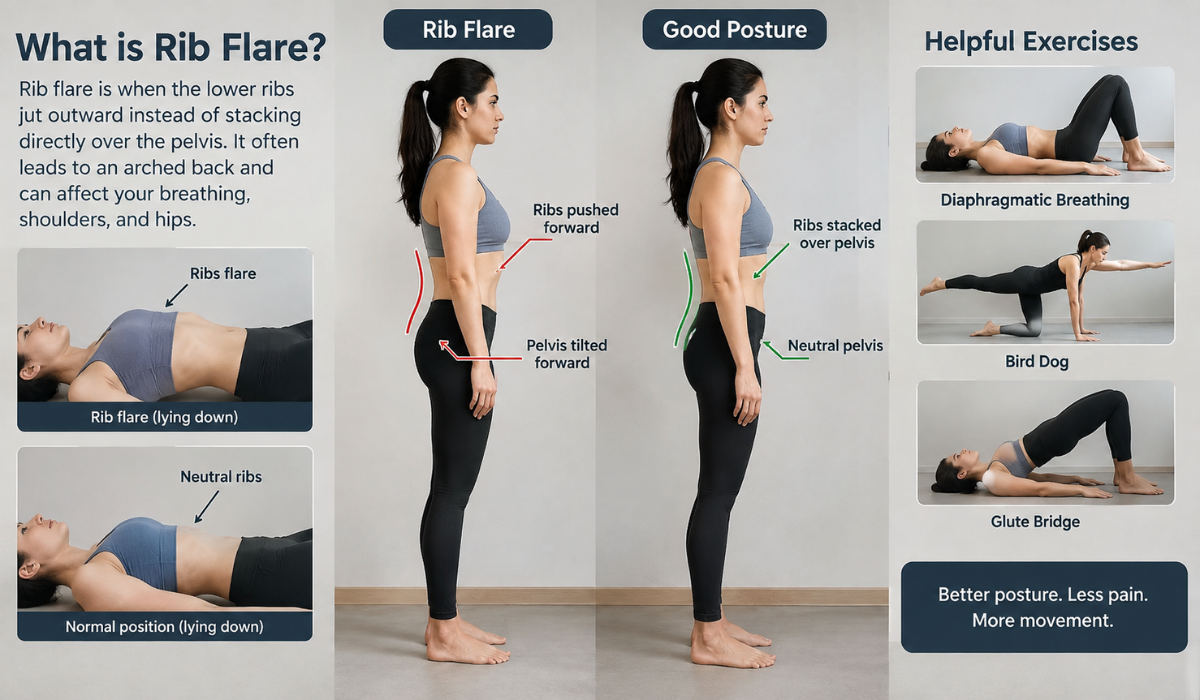
If you’ve ever noticed someone lying on their back with the bottom of their rib cage jutting up toward the ceiling, or standing with their ribs visibly pushed forward under their shirt, you’ve seen rib flare. It’s a common postural pattern, but it’s often misunderstood as a simple cosmetic issue rather than what it really is: a sign of how the body is managing load, breathing, and balance.
This article explains what rib flare is, why it develops, how to recognize it, and what can be done to correct it — including specific exercises and coaching cues.
What Is Rib Flare?
Rib flare describes a position where the lower ribs project outward and upward relative to the pelvis, rather than sitting stacked directly above it. It’s most obvious when someone lies flat on their back — instead of the lower ribs settling toward the floor, they lift off, creating a visible gap or arch in the lower back.
Anatomically, rib flare is closely tied to excessive extension through the lower thoracic spine and lumbar spine. When the rib cage tips forward and up, the pelvis often follows by tilting forward as well, creating the classic “arched back, ribs out” silhouette.
It’s important to understand that rib flare isn’t just a static shape — it’s a strategy. The rib cage and pelvis normally work together as a coordinated unit, expanding and moving with breath and motion. When that relationship breaks down, the body finds alternative ways to stay upright and generate force, and rib flare is frequently one of those adaptations.
Why Rib Flare Develops
Human posture is a constant negotiation with gravity. To stay balanced, the body needs to distribute weight efficiently through the feet, hips, spine, and rib cage. When that system works well, the ribs stack over the pelvis, and force can move smoothly through the joints.
Several factors commonly contribute to rib flare:
Reduced hip and foot control. If the muscles responsible for controlling the hips and feet — particularly those involved in hip internal rotation and foot pronation — aren’t functioning well, the body’s center of mass tends to drift forward, toward the toes. To avoid tipping over, many people compensate by arching the lower back and flaring the ribs, using spinal extension as a counterbalance.
Breathing patterns. People who breathe primarily into the upper chest, rather than expanding the rib cage in all directions, often develop a rib cage that sits in a chronically flared, inhaled position. Over time, the muscles around the ribs adapt to this shortened, elevated pattern.
Body proportions. Rib flare doesn’t look identical in every body. People with wider, more flared rib cages naturally tend to compensate more through lumbar extension, while people with narrower rib cages may show more flare directly through the rib cage itself.
Habitual positioning. Prolonged standing with a forward-tipped pelvis, certain training habits (like consistently arching during overhead pressing), and sedentary postures can all reinforce the pattern over time.
Why Rib Flare Matters
Rib flare rarely stays isolated to the rib cage. Because the ribs, spine, pelvis, shoulders, and hips are all mechanically linked, a chronic flare tends to create a chain of downstream effects:
- Shoulders: When the ribs sit in an extended, flared position, the shoulder blades are often pulled down and pinned toward the spine. This can limit the shoulder blade’s ability to rotate upward, which in turn restricts overhead reaching and shoulder rotation.
- Hips: A flared rib cage is frequently paired with an anteriorly tilted pelvis, which can limit the hip’s ability to rotate internally and reduces how well the back of the hip can absorb and produce force.
- Low back: Sitting in extension for long periods increases compressive load on the lumbar spine, which may contribute to low-back discomfort over time, particularly during lifting or repetitive extension-based activities.
- Breathing: A rib cage stuck in an “inhaled,” flared position has less room to expand further, which can make full, diaphragmatic breathing more difficult and reinforce shallow, chest-dominant breathing.
In practical terms, this pattern often shows up as arching excessively during overhead lifts, shifting weight onto the toes during squats and lunges, or feeling restricted when trying to rotate the torso.
How to Recognize Rib Flare
Rib flare can usually be identified through a few simple observations:
- Lying down. With someone lying flat on their back, knees bent and feet on the floor, look at the lower ribs. In a neutral position, they should settle down toward the floor. If they stay lifted or pop upward, that’s a sign of flare.
- Standing posture. From the side, look at the relationship between the rib cage and pelvis. If the ribs sit noticeably ahead of the pelvis with an exaggerated curve in the low back, flare is likely present.
- Movement patterns. Watch for excessive low-back arching during overhead reaching or pressing, difficulty controlling a hip hinge, or a tendency to shift weight forward onto the toes during squats and lunges.
- Breathing. Notice whether breathing happens mostly in the chest and shoulders, with little movement in the sides or back of the rib cage.
None of these signs alone confirms rib flare, but together they build a clear picture.
How to Fix Rib Flare
Correcting rib flare isn’t about forcing the ribs down or “sucking in.” It’s about restoring the coordination between breathing, the rib cage, the pelvis, and the surrounding joints so the body no longer needs to rely on extension as its default stabilizing strategy. Below are three approaches that address different pieces of that puzzle.
1. Supported Rib Cage Breathing (Inverted Position)
This position uses gravity and body positioning to encourage the ribs to expand more evenly, especially toward the back and sides, rather than staying locked in an elevated, flared position.
How to do it:
- Lie face-down on a bench or elevated surface with the lower ribs supported.
- Position the hips slightly higher than the head, using a wedge, blocks, or an incline bench.
- Let the arms rest in a relaxed position, elbows bent, without shrugging the shoulders.
- Inhale slowly through the nose, focusing on expanding the ribs into the surface beneath you.
- Exhale fully and slowly, without collapsing or holding tension.
Repeat for several slow breath cycles. This drill helps loosen a rib cage that’s become stuck in a flared, extended position and shifts weight distribution away from the front of the body.
2. Supine Scapular Reach with Rib Control
This exercise addresses the shoulder restrictions that often accompany rib flare by combining breathing with controlled arm reaching while keeping the rib cage anchored.
How to do it:
- Lie on your back with the feet elevated on a bench or box, knees bent to roughly 90 degrees.
- Place a small pad or rolled towel under the lower back to gently discourage excessive arching.
- Keep the feet together and let the knees fall open slightly.
- Reach both hands toward the inner thighs, keeping the head and neck relaxed on the floor.
- Inhale, allowing the ribs to expand, then exhale as you press the heels down and reach a little further.
This drill helps the shoulder blades move more freely while training the ribs to stay connected to the pelvis rather than lifting into extension.
3. Elevated Split Stance with Anterior Load
This exercise trains the hips and rib cage to work together under load, teaching the body to generate force without defaulting to spinal extension.
How to do it:
- Set up in a split stance with the front foot elevated slightly on a small platform or plate.
- Hold a light weight or resistance band in front of the chest, similar to a Zercher hold.
- If using a band, anchor it in front of you so it gently pulls you forward, requiring active control to resist.
- Inhale on the way down into the lunge, and exhale as you press back up.
- Focus on keeping the ribs drawn back over the pelvis throughout the movement, rather than letting them flare forward.
This drill reinforces hip control and rib positioning simultaneously, which is often more effective than addressing either piece in isolation.
Key Takeaways
- Rib flare is a position where the lower rib cage sits forward and upward relative to the pelvis, usually linked to excessive extension through the lower back and rib cage.
- It commonly develops as a compensation for reduced hip and foot control, chest-dominant breathing habits, or prolonged postural patterns.
- Left unaddressed, rib flare can limit shoulder mobility, hip rotation, and full diaphragmatic breathing, while increasing compressive stress on the low back.
- Correcting rib flare involves restoring rib cage breathing, retraining scapular movement, and building hip control under load — not simply trying to hold the ribs down through muscle tension alone.
- These exercises are best used as part of an ongoing routine rather than a single-session fix, since long-standing postural patterns typically take consistent practice to change.
Frequently Asked Questions
What causes rib flare? Rib flare is usually caused by a combination of factors, including reduced control through the hips and feet, chest-dominant breathing patterns, and habitual postures that encourage the lower back and rib cage to sit in extension. Individual rib cage shape can also influence how noticeable the flare appears.
Is rib flare the same as poor posture? Not exactly. While rib flare does affect posture, it’s more accurately described as a compensation strategy the body uses to stay balanced and generate force, rather than simple carelessness about how someone stands or sits. Addressing it usually requires more than just a verbal reminder to “stand up straight.”
Can rib flare cause back pain? Rib flare itself isn’t a diagnosis, but the extended spinal position associated with it can increase compressive load on the lumbar spine over time, which may contribute to discomfort for some people, especially during repetitive lifting or extension-heavy activities.
How long does it take to correct rib flare? This varies from person to person and depends on how long the pattern has been present, how consistently corrective exercises are practiced, and other individual factors. Many people notice changes in awareness and control within a few weeks of consistent practice, though fully retraining the pattern during all daily activities can take longer.
Can breathing exercises alone fix rib flare? Breathing exercises are an important piece of addressing rib flare because they directly influence rib cage position and mobility. However, since rib flare is typically linked to hip, pelvis, and shoulder mechanics as well, combining breathing work with movement-based exercises tends to produce more complete and lasting results.
Should I see a professional for rib flare? If rib flare is accompanied by pain, significant mobility restrictions, or doesn’t improve with consistent practice of corrective exercises, it may be worth consulting a physical therapist, athletic trainer, or other qualified movement professional who can assess the pattern in more detail and tailor a plan accordingly.