

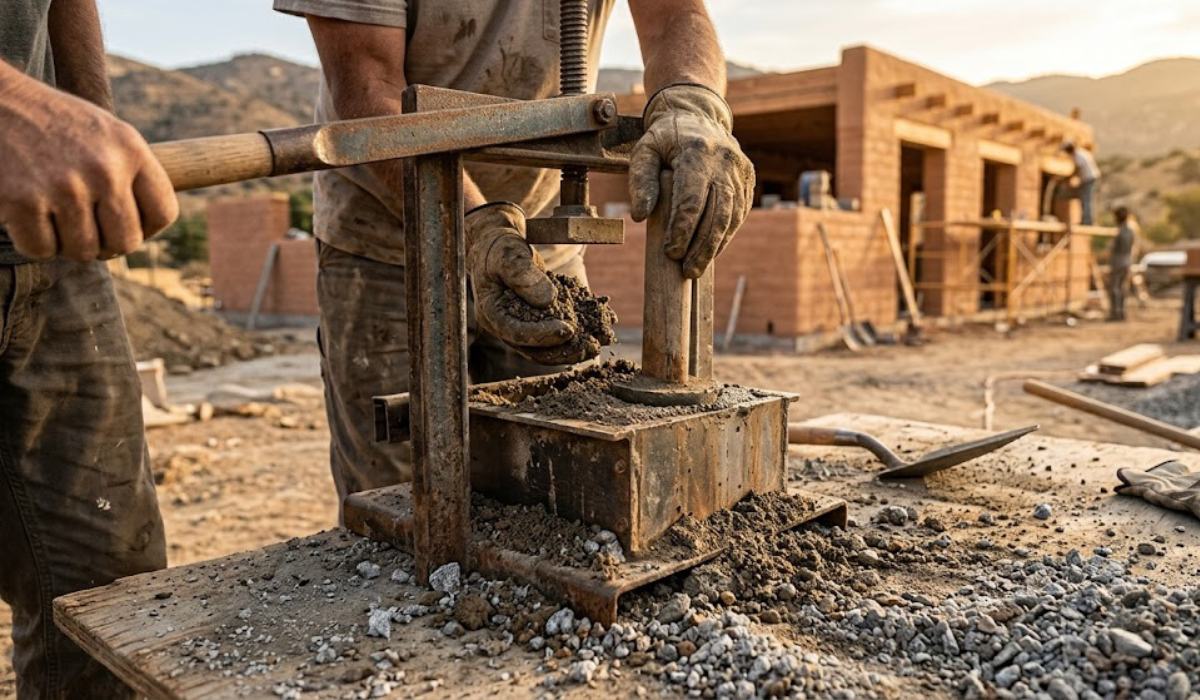
California is a state of contrasts a leader in modern tech innovation and also home to one of the most active sustainable building movements in the United States. Among the many low-carbon construction methods gaining traction here, Compressed Stabilized Earth Blocks (CSEB) stand out for their use of locally sourced soil materials. One soil type that often comes up in conversations among California builders and natural builders is decomposed granite (DG) — the gritty, sandy material that blankets much of the state’s foothills, desert edges, and chaparral zones.
But is decomposed granite actually a good material for making CSEB in California? The answer is nuanced and depends on several geological, climatic, and structural factors. This article digs into the science and practice behind using DG for CSEB production — so you can make an informed decision for your next build.
What Is CSEB? A Quick Overview
Compressed Stabilized Earth Blocks (CSEB) — also called compressed earth blocks (CEB) when no stabilizer is used — are building blocks made by compressing a mixture of soil and a small percentage of stabilizer (usually Portland cement, lime, or a pozzolanic material) into dense rectangular blocks using a manual or hydraulic press.
The resulting blocks are stackable, load-bearing, and thermally efficient. They are widely used in sustainable and vernacular architecture around the world. In California, interest in CSEB has grown notably in rural, off-grid, and fire-resilient construction — especially in areas where wood-frame buildings face increasing fire risk.
Key Fact: A well-made CSEB block typically contains 70–80% soil/aggregate, 5–12% cement or lime stabilizer, and just enough moisture to allow proper compaction — usually 8–12% by weight.
What Is Decomposed Granite?
Decomposed granite is a geological material formed when granite rock — one of California’s most abundant bedrock types — weathers and breaks down over time through physical and chemical processes. The result is a crumbly, granular material that ranges from coarse gravel-sized fragments to fine sandy particles.
DG is extremely common across California’s Sierra Nevada foothills, the Transverse Ranges, the Peninsular Ranges (including San Diego County), and in parts of the Central Valley edges. It is widely sold as a landscaping material and road-base stabilizer, which means it is commercially available at relatively low cost in many parts of the state.
Its particle composition typically includes:
- Quartz grains (hard, angular to sub-angular)
- Feldspar fragments (some weathered to clay minerals like kaolinite)
- Mica flakes (can affect cohesion)
- Small amounts of natural clay fines (variable)
The Core Question: Is DG Suitable for CSEB?
For any soil to work well in CSEB, it needs to meet certain textural and mineralogical criteria. The ideal CSEB soil is often described as a well-graded mixture containing:
- 50–70% sand and gravel (coarse fraction)
- 10–30% silt
- 5–20% clay (for binding)
- Low organic content (ideally zero)
Decomposed granite, at first glance, matches much of this profile. It is primarily a sandy-gravelly material with a useful range of particle sizes. However, the critical variable is its clay content.
When DG Works Well
California DG that has undergone significant feldspar weathering can contain 8–18% kaolinite or other clay minerals in its fine fraction. When this is the case, DG can function as an excellent CSEB base material. The clay particles provide cohesion during compression, and the angular quartz grains create a strong interlocking particle structure once pressed and stabilized.
In practice, builders in Southern California’s Inland Empire and parts of the Sierra foothills have successfully used local DG blended with 6–10% Portland cement to produce blocks that meet or exceed standard compressive strength targets for single-story residential construction (typically 2–4 MPa for unstabilized, 5–10 MPa for stabilized blocks).
When DG Underperforms
Not all DG is created equal. Freshly broken DG from high-elevation granite terrain — such as parts of the Eastern Sierra — may have very low clay content (under 5%), making it essentially a clean sandy gravel. Without adequate clay, compressed blocks will crumble under tension and have poor cohesion even with cement stabilization. In these cases, the DG must be amended with additional clay-rich soil before it can be used for CSEB.
Rule of Thumb: Perform a simple jar sedimentation test (also called the “bottle test”) on your DG sample. Fill a clear jar 1/3 with DG, add water to 2/3 full, shake vigorously, and let it settle for 24 hours. The sand settles first (bottom), silt in the middle, and clay stays suspended on top. You want the clay layer to represent roughly 10–20% of the total sediment height.
Comparing DG to Other California Soils for CSEB
| Soil Type | Clay Content | Compressive Strength (est.) | Availability in CA | CSEB Suitability |
|---|---|---|---|---|
| Decomposed Granite (weathered) | 8–18% | Good (5–9 MPa stabilized) | Very High | ✅ Good with stabilizer |
| Decomposed Granite (fresh) | 2–5% | Poor without amendment | High | ⚠️ Needs clay amendment |
| Adobe / Alluvial Soil | 25–45% | Moderate (shrink risk) | Moderate | ⚠️ Too much clay |
| Mixed Subsoil (loamy) | 15–25% | Excellent (7–12 MPa) | Moderate | ✅ Ideal |
| Sandy Desert Soil | <5% | Very Poor | High (desert regions) | ❌ Not suitable alone |
Stabilization Options for DG-Based CSEB in California
When using decomposed granite for CSEB, the choice of stabilizer matters enormously — both for structural performance and environmental sustainability.
Portland Cement
The most commonly used stabilizer. A 6–10% addition by dry weight significantly increases compressive strength and water resistance. Works well with DG because the silica in granite particles can react with cement hydration products over time. Widely available across California at low cost.
Lime
Lime stabilization is particularly effective when DG contains moderate to high clay content (above 10%). Lime reacts with clay minerals through pozzolanic reactions, strengthening the matrix. It also raises the pH, which reduces susceptibility to certain California soils’ expansive clay behavior. However, lime-stabilized blocks require longer curing times (28–90 days).
Natural Pozzolans
California is uniquely rich in natural pozzolans volcanic ash and pumice deposits from the Cascades and the Eastern Sierra can serve as low-carbon stabilizers. Some experimental builders in Northern California have successfully combined DG with rice husk ash and natural pozzolans to create blocks with competitive strength and a much lower carbon footprint than cement-stabilized alternatives.
Advantages and Disadvantages of Using DG for CSEB in California
✅ Advantages
- Extremely abundant and low-cost throughout California
- Well-graded particle size distribution in weathered DG
- Angular particles improve block interlocking and strength
- Low organic content means minimal decomposition risk
- Compatible with cement, lime, and pozzolanic stabilizers
- Supports local sourcing and reduced material transport
- Non-expansive (unlike high-clay soils) — minimal shrinkage cracking
⚠️ Disadvantages
- Clay content varies widely — testing is mandatory
- Low-clay DG needs amendment before use
- Mica content in some DG can reduce block cohesion
- Seismic performance must be engineered carefully (CA seismic zones)
- Not yet covered by most California building codes — permits complex
- Requires consistent moisture control during production
California-Specific Considerations
Seismic Safety
California is one of the most seismically active regions in the world, and this is perhaps the most critical consideration for any CSEB project. Unreinforced earth block construction performs poorly in earthquakes. For California projects, CSEB walls typically require horizontal and vertical reinforcement bars embedded in grouted cores or bond beams — similar to reinforced masonry construction. Engineers experienced in earthen construction are strongly recommended.
Moisture and Rain Exposure
While California is predominantly dry, coastal regions receive significant winter rainfall, and DG-based CSEB without adequate cement stabilization can soften and erode when wet. Proper roof overhangs (minimum 18–24 inches), waterproof wall bases, and exterior plaster coatings are essential in any climate zone with over 12 inches of annual rainfall.
Permitting and Code Compliance
CSEB construction is not yet recognized by California’s standard building code (CBC). Builders must typically apply for an Alternative Materials and Methods (AMM) approval under CBC Section 104.11, or work within jurisdictions that have adopted earth building appendices. Counties like San Luis Obispo, Fresno, and Humboldt have historically been more receptive to natural building methods.
Practical Steps to Test and Use DG for CSEB
Before committing to DG for a CSEB project, follow this simple testing and production protocol:
- Collect representative DG samples from your actual site — soil composition varies by depth and location.
- Perform a sedimentation jar test to visually assess sand, silt, and clay proportions.
- Conduct an Atterberg Limits test (liquid limit and plastic limit) if possible — ideal plastic limit for CSEB is 15–20%.
- Make trial blocks at 3–4 cement percentages (6%, 8%, 10%, 12%) and cure for 28 days.
- Perform a drop test: drop cured blocks from 1 meter height — blocks should not break.
- Test for water resistance: submerge blocks for 24 hours and retest compressive strength.
- Adjust mix ratios based on results and proceed to full production.
Frequently Asked Questions
Q1: Can I use bagged decomposed granite from a landscape supply store to make CSEB blocks?
Commercially sold landscape DG is often screened and may have had clay fines removed for drainage purposes. This makes it less suitable for CSEB without adding back a clay amendment. Always test clay content before use. Raw, unscreened DG from a quarry or natural site is generally more appropriate for block-making.
Q2: How much cement do I need to stabilize decomposed granite CSEB blocks?
For most California DG samples with moderate clay content (8–15%), a cement addition of 6–10% by dry weight is standard. Higher cement percentages increase strength but also cost and carbon footprint. Testing trial blocks at multiple percentages before full production is always recommended.
Q3: Are decomposed granite CSEB blocks fire-resistant?
Yes — one of the most significant advantages of CSEB in California’s wildfire-prone landscape is their inherent fire resistance. Compressed earth blocks are non-combustible and will not contribute to flame spread. In fact, several natural building advocates specifically recommend CSEB for construction in California’s Wildland-Urban Interface (WUI) zones.
Q4: Is it legal to build with CSEB in California?
CSEB is not explicitly recognized in the California Building Code (CBC), meaning builders must seek Alternative Materials and Methods approval. Some California counties, particularly in rural areas, are more open to earthen construction. Working with a structural engineer and a knowledgeable building department liaison is strongly advised before starting a CSEB project.
Q5: What is the compressive strength of a decomposed granite CSEB block?
Properly stabilized DG-based CSEB blocks can achieve compressive strengths of 5–9 MPa (megapascals), which is comparable to hollow concrete masonry units and more than sufficient for single-story load-bearing wall construction. Blocks with inadequate clay or stabilizer may fall below 2 MPa, making them unsuitable for structural use.
Q6: Does decomposed granite CSEB perform well in California’s hot, dry climates?
Yes — CSEB has excellent thermal mass properties. Decomposed granite-based walls absorb heat during the day and release it slowly at night, which is ideal for California’s inland desert and semi-arid climates. This can significantly reduce air conditioning loads compared to lightweight wood-frame construction, contributing to energy efficiency and lower utility bills.
Q7: What is the difference between CSEB and traditional adobe blocks?
Traditional adobe blocks are made from high-clay soil mixed with straw, formed in molds, and air-dried — they are not compressed and generally weaker and more water-sensitive. CSEB blocks are mechanically compressed under high pressure and often stabilized with cement or lime, resulting in blocks that are denser, stronger, more dimensionally uniform, and significantly more water-resistant than traditional adobe.