

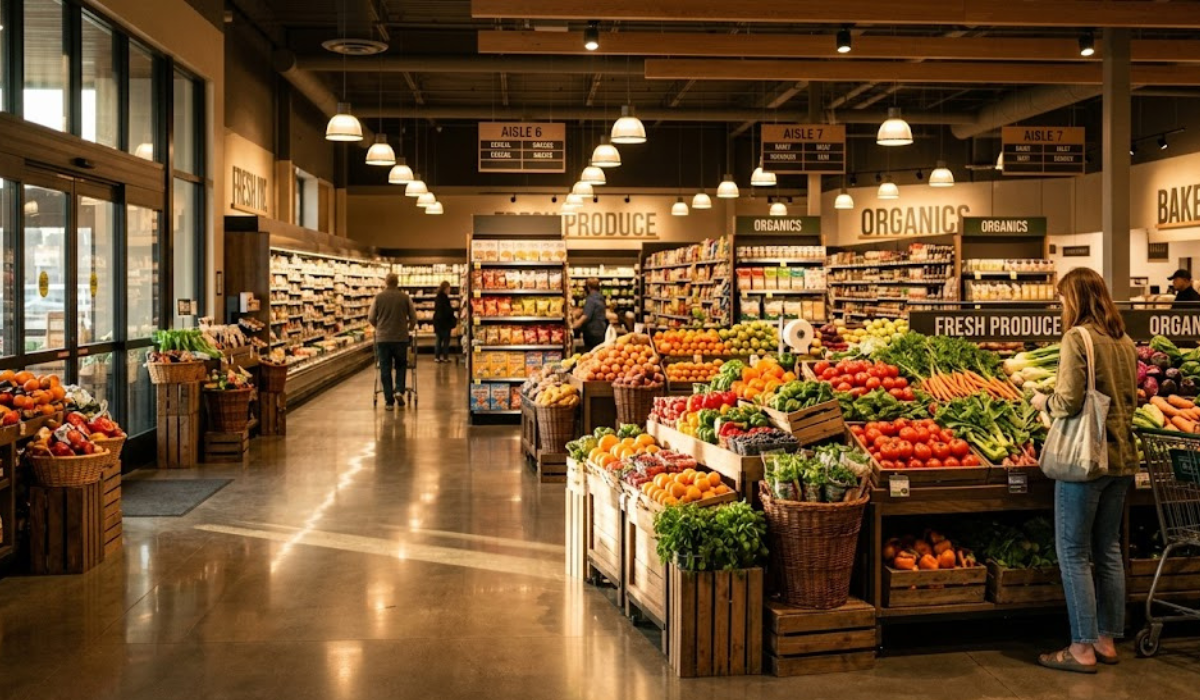
Walk into almost any town or city on Earth and you will find one. It hums quietly under fluorescent lights. It smells faintly of fresh bread and cold air. Its shelves hold thousands of products from dozens of countries. The supermarket is so woven into daily life that most of us give it almost no thought at all — yet it is one of the most transformative inventions of the modern era, reshaping not just how people buy food, but how they live, plan, and even think.
This guide takes a deep and honest look at the supermarket: where it came from, how it works, what it does to your mind when you step inside, and where it is headed as technology accelerates beyond recognition.
A Brief History of the Supermarket
Before the supermarket existed, buying food was a day-long undertaking. A household might visit the butcher, the greengrocer, the baker, the fishmonger, and the dry-goods merchant — each a separate trip, a separate transaction, a separate relationship. Milk and other short-shelf-life goods were delivered directly to customers’ doorsteps by a milkman, and these small retailers formed the final links in what was described as a ‘long and tortuous food chain.’
The first crack in this fragmented system came not with the supermarket itself, but with a quieter revolution: self-service. Clarence Saunders’s Piggly Wiggly stores, established in Memphis in 1916, are widely credited with introducing America to self-service shopping — the radical idea that customers could pick products from shelves themselves, rather than asking a clerk to retrieve each item. The efficiency was immediately obvious.
The first true supermarket as we know it today opened in 1930 in Queens, New York, when King Kullen set the template by fulfilling all five criteria that define the modern format: separate departments, self-service, discount pricing, chain marketing, and volume dealing. Its founder, Michael Cullen, understood something powerful — that combining scale, convenience, and low prices under a single roof was not just a better shop, it was a fundamentally different kind of institution.
Following King Kullen’s lead during the 1930s, grocery retailers such as Kroger, Safeway, and A&P began consolidating thousands of smaller shops into a smaller number of larger supermarkets. While the number of individual stores fell, overall sales skyrocketed as people flocked to the new format.
Key Milestones in Supermarket History
- 1916 — Piggly Wiggly opens in Memphis: self-service shopping is born
- 1930 — King Kullen launches in Queens, New York: the first true supermarket
- 1950s–60s — Post-war suburban boom drives supermarket expansion across America
- 1970s–80s — Barcodes and electronic registers transform checkout efficiency
- 1990s — Loyalty cards and data collection reshape marketing
- 2016 — Amazon Go pilots the first cashierless convenience store
- 2020s–present — AI, smart carts, and hyper-personalization redefine the experience
The post-World War II economic boom ushered in a golden age for the supermarket, driven by the rapid rise of suburban living. During the 1950s and 1960s, modern supermarkets with eye-catching designs proliferated across the continent’s burgeoning suburbs — so novel that, as the story goes, Queen Elizabeth II and Prince Philip made a point of visiting a Maryland grocery store during their 1957 visit to the United States just to witness the spectacle firsthand.
✦ ✦ ✦
Inside the Design: How Supermarkets Are Laid Out
Nothing inside a supermarket is accidental. Every aisle angle, shelf height, and product placement is the result of extensive research into how human beings move, notice, and decide. Understanding this design language is one of the most practical things a shopper can do.
The Produce Section at the Front
As you step into a supermarket, the first section you typically encounter is the produce department. Brightly colored fruits and vegetables not only create a welcoming atmosphere but also trigger a ‘health halo’ effect, making shoppers more inclined to make additional purchases in the belief that their overall basket will be equally wholesome. It is a deliberate psychological warm-up.
Essentials at the Back
Staples like milk and eggs are deliberately placed at the back of the store, forcing shoppers to navigate through various aisles and increasing the likelihood of unplanned purchases along the way. The journey through the store is not random — it is a route carefully engineered to maximize exposure to products you did not come to buy.
Eye-Level Is Buy-Level
Supermarkets place high-margin products at eye level, making them more noticeable and accessible. Less expensive or generic brands tend to appear on lower shelves, requiring shoppers to look harder to find them. This practice is so well-established it has a nickname in retail: ‘eye level is buy level.’
The Power of Scent and Sound
Sellers have long understood the power of smell to entice customers. The aroma of freshly baked goods from the bakery section, the smell of coffee near the coffee aisle, or floral scents near the flower department can evoke positive emotions and improve the overall shopping experience. Background music is similarly calculated — slower tempos have been shown to slow shoppers down, increasing time spent (and money spent) in the store.
‘The layout of a supermarket is not a random design choice — it is a carefully crafted psychological strategy, built to influence every step of your shopping journey.’
Impulse Zones and the Checkout Lane
Items like gum, beverages, and chocolate are placed near the register where shoppers dwell longest, forming what retailers call ‘impulse zones.’ Wide central aisles guide traffic and create space for seasonal or promotional displays that invite curiosity. Even the width of the cart you are given is not neutral — larger carts quietly encourage larger purchases.
✦ ✦ ✦
What Supermarkets Sell Beyond Food
The modern supermarket has expanded far beyond groceries. Walk through any large-format store today and you are likely to find a pharmacy, a bank branch, a dry-cleaning counter, a flower shop, a photo printing service, and a cafe. Some carry electronics, clothing, and seasonal home goods. This sprawl is deliberate — the more reasons a customer has to visit, and the more time they spend inside, the more they tend to spend overall.
This diversification has also responded to consumer demand for convenience. In an era of compressed schedules, the appeal of handling multiple errands in a single stop is enormous. The supermarket has quietly evolved from a food retailer into a full-service hub for household management.
✦ ✦ ✦
The Digital Transformation of the Supermarket
The supermarket of 2026 looks familiar from the outside. Inside, however, it is undergoing its most significant transformation since King Kullen opened in 1930.
Self-Checkout and Cashierless Technology
The global market for self-checkout solutions is projected to reach a value of USD 18.01 billion by 2032, driven by consumer demand for faster and contactless shopping. Beyond standard self-checkout kiosks, more advanced cashierless systems — pioneered by Amazon Go — allow shoppers to pick up items and simply walk out, with purchases automatically charged to their accounts via cameras and sensors.
Smart Carts
Smart carts are now equipped with RFID sensors, digital displays, barcode scanners, and store-network connectivity. These carts can provide product information, help shoppers locate items, offer personalized promotions, and even process payment directly from the cart itself. The checkout line, a fixture of supermarket life for nearly a century, may soon disappear entirely.
AI and Personalization
According to Deloitte, automation and AI are fast becoming essential in how supermarkets manage everything from stock levels to personalized shopping experiences. Almost nine in ten grocery executives say the marketing of groceries will become hyper-personalized in the coming years.
AI in grocery is expected to create nearly $136 billion in value for the sector overall, with big retailers actively implementing AI and robotics to automate in-store, back-office, and warehouse processes. Algorithms already analyze individual purchase histories to generate personalized offers, adjust pricing dynamically based on demand, and predict which products will need restocking before shelves run empty.
Online Grocery and Dark Stores
The rise of online grocery delivery — accelerated dramatically by the pandemic years — has given rise to a new concept: the ‘dark store,’ a warehouse that resembles a supermarket in layout but is closed to the public, operated entirely by robots and human pickers fulfilling online orders. These facilities allow retailers to serve digital shoppers without the overhead of a consumer-facing floor.
✦ ✦ ✦
Supermarkets and Sustainability
Few industries have as large an environmental footprint as food retail. Supermarkets consume enormous amounts of energy through refrigeration alone, generate significant packaging waste, and sit at the center of complex global supply chains. In response, many large chains have committed to reducing food waste, transitioning to renewable energy, and cutting down on single-use plastics.
Food waste reduction is perhaps the most urgent challenge. Supermarkets discard millions of tons of edible food annually due to aesthetic standards, overstocking, and sell-by date policies. New approaches — including dynamic pricing that reduces the cost of near-expiry items in real time — are beginning to chip away at this problem. Some chains partner with redistribution charities, ensuring that unsold food reaches people who need it rather than landfill.
✦ ✦ ✦
Smart Shopping: How to Navigate a Supermarket Better
Knowing how supermarkets are designed puts shoppers in a stronger position. A few evidence-based habits can meaningfully reduce spending and improve the experience:
Shop with a list. Research consistently shows that shoppers without lists spend significantly more, driven by the visual and sensory cues the store is designed to activate. A written list — especially one organized by store section — keeps focus sharp.
Never shop hungry. This is not a cliché; it is neuroscience. Studies show that hunger increases desire for high-calorie, high-margin foods and reduces rational decision-making at the shelf.
Look up and look down. The products at eye level are there because retailers pay a premium for that placement. The comparable product one shelf down is often equally good — and cheaper.
Beware of ‘unit pricing’ differences. A larger package is not always a better deal per gram or per milliliter. Check the unit price, not the headline price.
Take your time at the perimeter. Fresh produce, meat, dairy, and bakery goods — the most nutritious items — tend to line the outer edges of a supermarket. Processed and packaged goods fill the inner aisles. A perimeter-first strategy is both healthier and often more economical.
✦ ✦ ✦
Frequently Asked Questions
What is the difference between a supermarket and a grocery store?
A grocery store is typically smaller and focuses primarily on food and drink. A supermarket is a larger-format retailer that combines multiple departments — produce, meat, dairy, bakery, frozen foods, household goods, and often pharmacy or banking services — under one roof. The term ‘supermarket’ usually implies a full self-service experience and a significantly wider product range.
When did the first supermarket open?
The first store widely recognized as a true supermarket was King Kullen, which opened in Jamaica, Queens, New York in August 1930. However, elements of the modern supermarket — particularly self-service shopping — trace back to Clarence Saunders’s Piggly Wiggly chain, founded in Memphis, Tennessee, in 1916.
Why are staples like milk and eggs placed at the back of the supermarket?
This is a deliberate layout strategy. Because these items are on almost every shopper’s list, placing them at the far end of the store ensures that customers must walk through the entire floor — passing hundreds of other products — before reaching what they came for. This exposure increases the chance of unplanned purchases along the way.
How do supermarkets use psychology to influence shoppers?
Supermarkets use a wide range of psychological techniques: placing high-margin products at eye level, using fresh produce near the entrance to create a ‘health halo,’ piping in the scent of baked goods, playing slower music to reduce walking pace, positioning impulse items near checkout lanes, and designing layouts that require shoppers to travel the maximum distance to reach essential goods.
What is a cashierless or ‘just walk out’ supermarket?
A cashierless store uses a combination of computer vision cameras, weight sensors, and artificial intelligence to track items as shoppers pick them up. When the customer exits, the total is automatically charged to their linked payment account — no scanning, no checkout, no waiting. Amazon Go pioneered this technology, and it is now being adopted by other retailers globally.
Are supermarkets bad for the environment?
Supermarkets do carry a significant environmental footprint, particularly through refrigeration energy use, packaging waste, and food waste. However, many chains are actively working to reduce their impact through renewable energy commitments, plastic reduction policies, and food redistribution programs. Buying in-season, local produce and reducing food waste at home are the most impactful steps consumers can take.
What is the future of supermarkets?
The future of supermarkets is likely to combine the physical and digital experience more seamlessly. Expect AI-driven personalization, smart carts that eliminate checkout lines, real-time dynamic pricing, robotic restocking, and a growing share of orders fulfilled through online platforms and dark stores. The in-store experience will likely evolve toward community, discovery, and fresh food — the things that digital channels cannot replicate.