

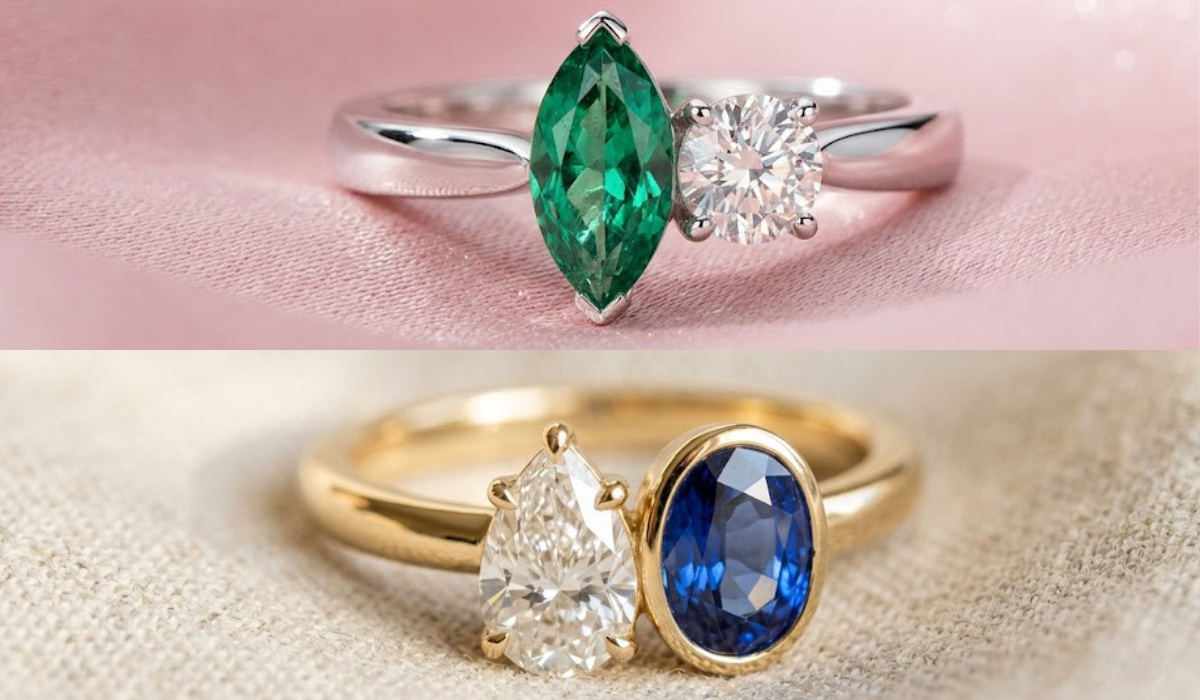
When two people decide to spend their lives together, the ring that marks that decision often carries more meaning than its sparkle alone. Among the many engagement ring styles that have come and gone in popularity, one design has managed to stay relevant for more than two centuries: the toi et moi engagement ring. Its French name, which simply means “you and me,” hints at the emotional concept behind the design two separate stones, two separate identities, placed together in a single piece of jewelry to represent a union.
Unlike a traditional solitaire ring, which centers attention on one diamond, the toi et moi style is built around duality. It doesn’t ask the wearer to choose just one gemstone or one shape. Instead, it invites two stones to sit side by side, each maintaining its own character while contributing to a single, unified design. This article looks at what makes this ring style distinct, where it came from, why it continues to resurface generation after generation, and what people should understand about it before considering one for themselves.
What Exactly Is a Toi et Moi Ring?
At its core, a toi et moi ring is an engagement or commitment ring that features two main gemstones positioned next to each other on the same band, rather than a single center stone flanked by smaller accent stones. The two stones are generally considered equally important to the design. They don’t have to match in cut, colour, or even size, although many couples prefer a sense of visual balance between them.
This is what separates a toi et moi ring from other multi-stone designs, such as a three-stone “trilogy” ring, which usually has one larger center stone with two smaller stones on either side representing the past, present, and future of a relationship. A toi et moi ring, by contrast, has no single dominant stone. The entire point of the design is that neither gem overshadows the other they exist in partnership, much like the two people the ring represents.
Some couples choose two diamonds in different shapes, such as a pear-cut diamond paired with an oval or cushion cut. Others choose a diamond alongside a colored gemstone like a sapphire, emerald, or ruby. Birthstones are also a common choice, allowing each stone to represent one half of the couple personally rather than symbolically. There is no fixed rule for how the stones should be combined, which is part of why the design has remained so adaptable across different eras and personal styles.
Where the Toi et Moi Ring Came From
The story most often credited with popularizing the toi et moi ring dates back to the late 18th century. The design’s history traces to 1796, when Napoleon Bonaparte proposed to Joséphine de Beauharnais with a ring of this style. His ring featured a pear-shaped sapphire paired with a diamond, with each stone meant to represent one half of the couple. At the time, their relationship itself was considered unconventional, since Joséphine was a widow and older than Napoleon, which was unusual for a match of that social standing. The ring, in a sense, became a quiet declaration that two different people, from different circumstances, were choosing to move forward as equals.
What’s notable is that the ring did not need elaborate detail to make its point. The strength of the symbolism came from the simple act of placing two stones beside one another rather than from elaborate craftsmanship. This early example helped establish the toi et moi style as a popular choice among European aristocracy in the years that followed. During the Victorian era specifically, the design saw a notable rise in popularity, often appearing with detailed engravings, filigree work, and birthstone settings that gave each ring a more personal story.
Centuries later, the design resurfaced in some of the most recognized engagements in modern history. Jackie Kennedy’s engagement ring from John F. Kennedy in 1953 featured a diamond of nearly three carats paired with an emerald of a similar weight, and it remains one of the most referenced toi et moi rings of the 20th century. In 1966, Queen Margrethe II of Denmark received a Van Cleef & Arpels toi et moi ring with two cushion-shaped diamonds, each weighing around six carats, from her husband Henri de Laborde de Monpezat. These moments helped keep the design connected to royal and high-society engagements long after Napoleon’s era had passed.
Why the Style Has Returned to Popularity
Engagement ring trends tend to move in cycles, and the toi et moi ring’s recent resurgence is tied to a few overlapping cultural shifts rather than a single cause.
One driving factor has been visibility through celebrity engagements. High-profile engagements, including those involving distinctive two-stone designs, have introduced the toi et moi style to a new generation of people who may not have been familiar with its history. When a recognizable public figure wears an unconventional ring, it often sparks curiosity among people who are shopping for their own rings and are open to styles outside the standard solitaire.
Another factor is a broader shift in what couples want their engagement rings to represent. Many couples today are looking for ways to move away from traditional single-stone settings and want something that feels distinctive and personal rather than simply standard. The toi et moi design naturally supports this, since the entire structure of the ring is built around individuality coexisting with partnership.
Personalization plays a significant role as well. Because the design allows for nearly limitless gemstone combinations, couples can incorporate birthstones, favorite colors, or stone pairings that hold specific meaning to their relationship. A traditional solitaire ring doesn’t offer the same flexibility, since the entire design typically revolves around one stone. With a toi et moi ring, the second stone opens up a layer of customization that many couples find meaningful, especially when each partner is represented by their own birthstone or a gem chosen for a personal reason.
Finally, there’s the matter of aesthetics. Two stones placed side by side, particularly when paired in contrasting shapes or colors, tend to create a sense of visual movement that a single stone cannot replicate. This has made the design appealing not just for its symbolism, but simply as a striking piece of jewelry.
Common Stone Combinations and Their Meaning
While there’s no rulebook for how a toi et moi ring should be designed, certain combinations have become more recognizable over time.
A diamond paired with a colored gemstone is one of the most traditional approaches, echoing Napoleon’s original ring of a diamond and sapphire. In this kind of pairing, the diamond is often associated with enduring love and strength, while the colored gemstone is seen as a representation of individuality, giving the ring a layered meaning beyond simple aesthetics.
Two diamonds in different cuts is another widely chosen option. A pear-shaped diamond next to an oval, or a cushion cut beside an emerald cut, allows the ring to stay within a single gemstone type while still creating contrast through shape alone. This approach tends to appeal to those who want the brilliance associated with diamonds without introducing a second color into the design.
Birthstone pairings have also become increasingly common in modern versions of the ring. Rather than choosing stones purely for their visual contrast, some couples select gemstones that correspond to each partner’s birth month, turning the ring into something closer to a personal timeline than a purely decorative choice.
Pearls, though less common, have also appeared in toi et moi designs, typically paired with a diamond to create a softer, more understated contrast between texture and shine.
How a Toi et Moi Ring Differs From Other Multi-Stone Styles
It’s worth distinguishing the toi et moi ring from other engagement ring styles that also use more than one stone, since the terms are sometimes used loosely.
A three-stone ring, often associated with the idea of past, present, and future, places a larger stone in the center with two smaller stones flanking it. The visual hierarchy is clear, with one stone intended to draw the most attention.
A halo ring surrounds a single center stone with a ring of smaller diamonds, again keeping the focus on one primary gem.
The toi et moi ring, however, avoids this hierarchy altogether. Both stones are typically chosen to be close in size and visual weight, even if their shapes or colors differ. This absence of a clear “main” stone is what gives the design its specific symbolism: two equals, side by side, rather than one supported by smaller elements.
Things to Consider Before Choosing This Style
Anyone considering a toi et moi ring should be aware of a few practical points that don’t always come up in discussions about the design’s romantic symbolism.
Balance matters more than matching. The two stones don’t need to be identical, but most well-designed toi et moi rings maintain a sense of proportion between the stones so that one doesn’t visually dominate the other. This is something worth discussing with a jeweler, since carat weight, shape, and color can all affect how “balanced” two different stones appear once they’re set together.
Setting style affects durability. Because the ring holds two stones rather than one, the way each stone is secured—whether through prongs, a bezel, or a shared setting—can influence how well the ring holds up to daily wear. This is particularly relevant for anyone who plans to wear the ring regularly rather than for occasional use.
Resizing can be more complex. Rings with two large stones set close together can sometimes be more difficult to resize than a traditional solitaire, depending on how the stones are positioned on the band. This is a useful question to ask before finalizing a design.
Pairing with a wedding band requires some planning. Because toi et moi rings often have a wider or more asymmetrical profile than a solitaire, finding a wedding band that sits comfortably alongside it may take some additional thought, particularly if the band is meant to be worn stacked against the engagement ring daily.
A Design Built Around Partnership
What has allowed the toi et moi ring to remain relevant for more than 200 years isn’t simply its appearance, but the idea embedded in its structure. The ring doesn’t ask one stone to represent the entire relationship. Instead, it places two distinct elements together and lets them coexist, each visible, each intact, while still forming a single piece. That idea — two individuals, both fully themselves, choosing to move forward together — is part of why the design has resurfaced again and again across very different historical periods, from 18th-century France to modern engagements today.
For couples drawn to symbolism as much as style, the toi et moi ring offers something a traditional solitaire simply isn’t built to express: the visual representation of two people, rather than one moment.
Frequently Asked Questions
What does “toi et moi” mean? “Toi et moi” is French for “you and me.” The phrase is used to describe a ring style featuring two gemstones set side by side, with each stone symbolically representing one person in the relationship.
Where did the toi et moi ring originate? The design is most closely associated with Napoleon Bonaparte’s 1796 proposal to Joséphine de Beauharnais, when he presented her with a ring featuring a pear-shaped sapphire and a pear-shaped diamond set together.
Do the two stones in a toi et moi ring have to match? No. The stones can differ in shape, color, size, and even gemstone type. Many designs intentionally use contrasting shapes or colors, though some couples prefer stones that are closer in appearance for a more uniform look.
Is a toi et moi ring the same as a three-stone ring? No. A three-stone ring has one larger center stone flanked by two smaller stones, usually symbolizing the past, present, and future. A toi et moi ring has two stones of similar visual importance, with neither stone serving as a clear focal point over the other.
Can a toi et moi ring use birthstones instead of diamonds? Yes. Many modern versions of the ring use each partner’s birthstone in place of, or alongside, a diamond, which adds a personal layer of meaning specific to the couple.
Why has the toi et moi ring become popular again recently? Its recent resurgence has been linked to celebrity engagements that introduced the style to a wider audience, along with a broader shift among couples toward more personalized and less conventional engagement ring designs.
Is the toi et moi style only used for engagement rings? No. While it’s widely chosen as an engagement ring style, the same two-stone design has also been used for anniversary gifts, fashion rings, and pieces meant to represent non-romantic relationships, such as close family bonds.