

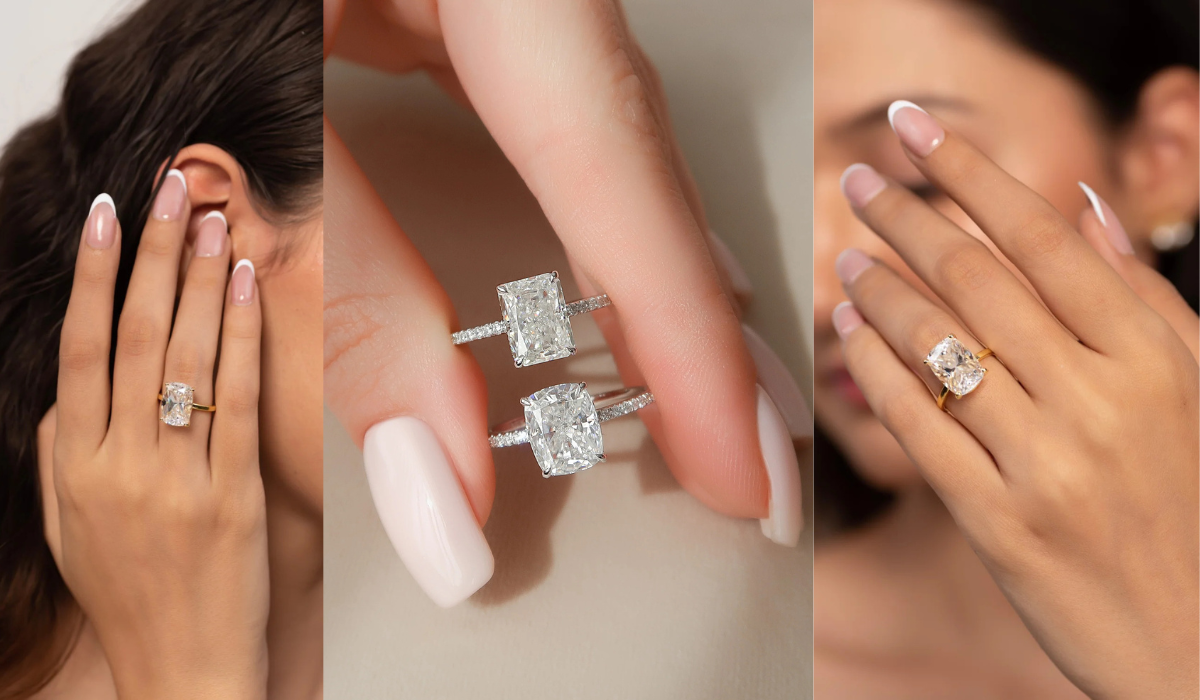
When people first encounter the term “elongated cushion cut,” they often picture something exotic or rare, but in reality it describes a fairly straightforward variation of one of the oldest diamond shapes in existence. The elongated cushion cut takes the soft, pillow-like silhouette of a traditional cushion cut and stretches it along one axis, producing a more rectangular or oval-leaning outline instead of the classic near-square form. This subtle shift in proportion changes the way the stone looks on the hand, how it catches light, and even how it pairs with different metal settings. Below is a detailed look at what this shape actually is, where it came from, how it behaves optically, and what to consider if you are trying to understand or evaluate one.
What Exactly Is a Cushion Cut, and How Does “Elongated” Change It?
A standard cushion cut is essentially a square or rectangular shape with rounded corners and broad, soft facets, often compared to a pillow or cushion, which is how it earned its name. The “elongated” version simply refers to a cushion cut whose length-to-width ratio is noticeably greater than 1:1. Instead of looking like a rounded square, an elongated cushion cut looks like a rounded rectangle, sometimes approaching an oval or emerald-like silhouette depending on how stretched the proportions are.
There is no single fixed ratio that defines “elongated.” Gemologists and jewelers generally consider anything above roughly 1.15:1 to start reading as elongated, with ratios between 1.3:1 and 1.5:1 being the most commonly chosen for a balanced, finger-flattering look. Beyond that range, the stone begins to resemble a cushion-cornered rectangle more than a traditional cushion shape.
A Brief History of the Cushion Cut Family
The cushion cut is one of the oldest diamond shapes still in use today, with roots tracing back to the “old mine cut” popular in the eighteenth and nineteenth centuries. Old mine cuts had high crowns, small tables, and large, open facets designed to maximize brilliance under candlelight rather than electric light. As cutting technology and lighting changed throughout the twentieth century, the shape evolved into what we now call the modern cushion cut, with better symmetry, more refined facet patterns, and improved light performance.
The elongated variation is not a separate historical shape so much as a proportional choice that became more popular as diamond cutters and designers began experimenting with how stretched silhouettes could create the illusion of greater size and a more elegant, finger-covering appearance. Over the past few decades, as antique-inspired and vintage-style jewelry design has grown in popularity again, the elongated cushion has become one of the more frequently discussed shapes among those researching diamond and gemstone cuts.
How Light Behaves in an Elongated Cushion Cut
One of the most distinctive features of any cushion cut, elongated or not, is its facet pattern. Cushion cuts typically fall into two broad style categories. The first is the “chunky” or large-faceted style, sometimes nicknamed the “crushed ice” look, which produces a flashier, more scattered sparkle pattern because light bounces off many small facets in different directions. The second is the more traditional, larger-faceted style that produces broader flashes of light and a calmer, more classic brilliance.
Elongating the shape can subtly affect this optical behavior. Because the stone is stretched along one axis, the facet pattern is also stretched, which can sometimes create slightly less uniform light return compared to a perfectly square cushion. This is not necessarily a flaw; many people are drawn to elongated cushions precisely because the light pattern looks a little less symmetrical and a little more organic or vintage in character. However, it does mean that cut quality and facet symmetry matter even more in an elongated cushion than in a square one, since uneven proportions can sometimes create a “bow-tie” effect, a dark shadow that appears across the center of the stone when facets are not aligned well.
Why People Are Drawn to This Shape
There are a few recurring reasons this particular silhouette comes up often in discussions about diamond and gemstone shapes. First, the elongated form tends to make a stone appear larger than its actual carat weight would suggest, because the surface area facing up is spread across a longer outline rather than concentrated in a compact square. Second, the rounded corners of a cushion cut make it a more forgiving shape for everyday wear compared to sharper-cornered shapes like emerald or princess cuts, since there are no pointed edges to catch on fabric or chip easily. Third, the elongated cushion sits in a stylistic middle ground between modern geometric shapes and softer vintage aesthetics, which makes it appealing to people who want a piece that feels timeless rather than tied to one particular era or trend cycle.
Factors That Influence How an Elongated Cushion Cut Looks
Several characteristics determine how a particular stone in this shape will ultimately appear once finished.
The length-to-width ratio is the most obvious factor, since it determines just how “stretched” the stone looks. A ratio close to 1.2:1 will still read as a fairly traditional cushion with just a slight elongation, while a ratio closer to 1.5:1 or higher will look much more like an elongated rectangle with soft corners.
Crown height and table size also play a significant role. A higher crown tends to produce more dispersion, meaning more of the rainbow-colored flashes sometimes called “fire,” while a flatter crown with a larger table tends to emphasize brightness and broader flashes of white light instead.
Facet pattern style, as mentioned earlier, determines whether the stone leans toward a scattered, sparkly “crushed ice” appearance or a calmer, more structured brilliance pattern with larger, more defined flashes.
Finally, symmetry and proportion consistency across the stone matter more in elongated shapes than in symmetrical ones, because any unevenness becomes more visually obvious once the shape is stretched along one direction.
How It Compares to Other Elongated Shapes
People researching this topic often want to understand how the elongated cushion differs from other elongated diamond shapes like the oval, the emerald cut, or the radiant cut. The oval shares the elongated silhouette but has no straight edges or defined corners at all, giving it a smoother, more continuous outline. The emerald cut is elongated as well, but its step-cut facet structure produces long, mirror-like flashes of light rather than the scattered brilliance typical of a cushion. The radiant cut combines a rectangular or square outline with brilliant-style faceting, making it visually closer to a cushion cut but with sharper, more clearly defined corners rather than the soft, rounded corners that define the cushion family.
A Note on Evaluating Any Cushion-Style Stone
Because the cushion shape, in either its square or elongated form, does not have as standardized a cut-grading system as round brilliant diamonds do, evaluating quality often relies more heavily on visual inspection and proportion analysis than on a single universal grading scale. This is part of why symmetry, facet alignment, and the absence of a noticeable bow-tie effect are frequently emphasized when people discuss how to judge a well-cut cushion stone of any proportion.
Frequently Asked Questions
What does “elongated cushion cut” actually mean? It refers to a cushion-shaped diamond or gemstone whose length is noticeably greater than its width, giving it a rectangular or slightly oval outline rather than the more square shape of a traditional cushion cut.
Is an elongated cushion cut the same as an oval cut? No. While both shapes are longer than they are wide, the oval has a continuous curved outline with no corners, while the elongated cushion retains soft, rounded corners and a more rectangular overall structure.
What ratio is considered “elongated” for a cushion cut? There is no single official standard, but a length-to-width ratio above approximately 1.15:1 is generally considered elongated, with ratios between 1.3:1 and 1.5:1 being the most commonly discussed as visually balanced.
Does an elongated cushion cut sparkle differently than a square one? The facet pattern stretches along with the shape, which can create a slightly different light pattern. Depending on the specific cut style, it may produce either a scattered “crushed ice” sparkle or broader, calmer flashes of light, similar to a square cushion but distributed across a longer outline.
What is the “bow-tie effect” mentioned in relation to this shape? It is a dark, bow-tie-shaped shadow that can appear across the center of an elongated stone when its facets are not evenly aligned. It is a common consideration when evaluating elongated shapes like cushions, ovals, and marquise cuts.
Why might a stone in this shape look larger than its actual weight suggests? Because the surface area is spread along a longer outline rather than concentrated into a compact square, more of the stone’s face is visible from a top-down view, which can create the impression of a larger size for the same carat weight.